Marketing validation

Southeast Asia Marketplace AI Listing Video 2026: Why Seller-Shot Footage Beats Ungated AI

Simulated Shopee and TikTok Shop buyers across Southeast Asia and Asia-Pacific rank an accurate seller-shot hero first and ungated AI listing video last. Put real product footage in the hero slot, and hold any AI creative until a buyer-panel check clears it. An AI-generated label alone does not.

Last updated
Statistics
50
By
Preferences AI
Evidence mix:Secondary source3PAI simulation · directional47
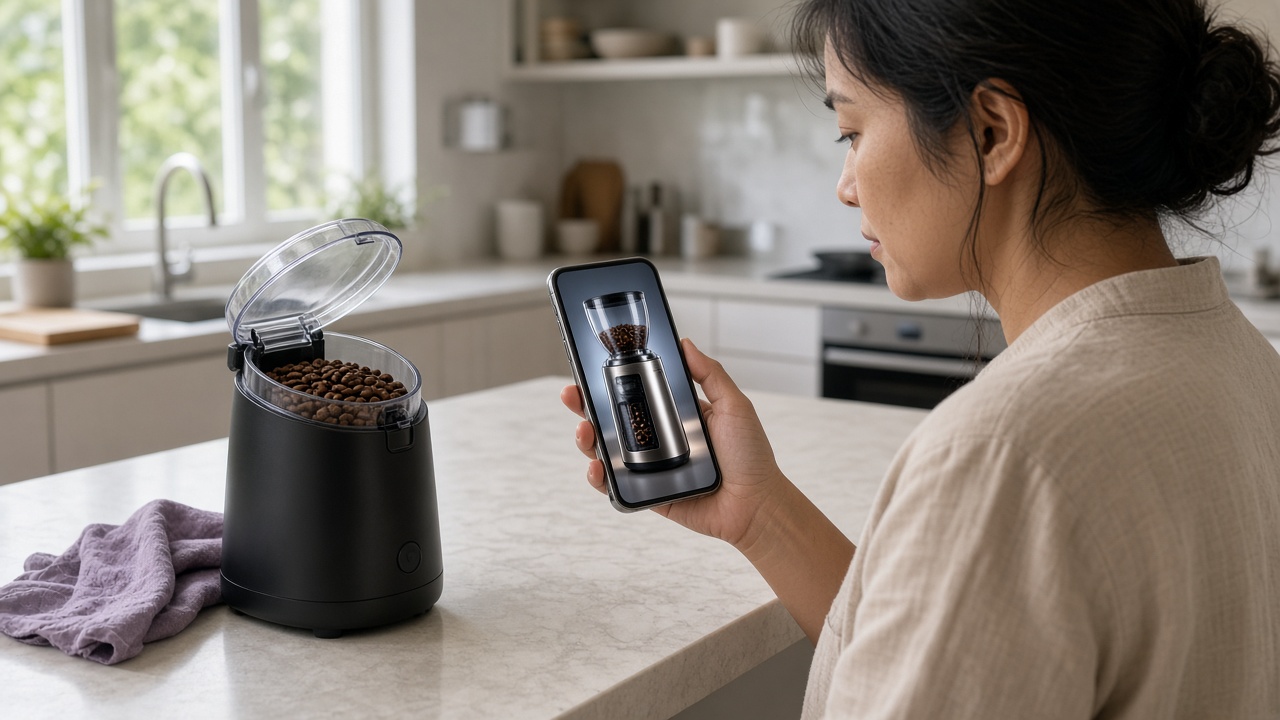
From just behind her right shoulder, a woman in an open kitchen looks at a product video of a sleek grinder on her phone, while the real grinder on the counter sits open with unground beans.

Key takeaways

  • An accurate seller-shot hero led simulated purchase intent at 3.99 out of 5, with a top-two score of 78.3% and the highest credibility (4.55 out of 5).
  • When forced to pick the next listing, simulated respondents chose seller-shot footage 66.3% of the time and seller-approved AI 33.7%. Ship-as-is and badge-only received 0%.
  • 100% wanted brands to validate AI creative with a buyer panel before it ships, and 58.7% seated validate-before-ship as the six-month default.
  • An AI badge alone was chosen by 0% as enough protection. 78.4% preferred an accuracy gate even without a badge.
  • After a mismatched AI video, simulated trust in that seller’s other listings averaged 1.88 out of 5, and 84.6% said they would move to accuracy-gated listings if ship-as-is continued.

Figures marked PAI simulation · directional are simulation outputs, not census or survey estimates. How we label data.

Why does listing-video policy matter for Southeast Asian marketplace sellers in 2026?

Ungated AI listing video is already a buyer-trust problem, and the blame lands on the seller.

On 25 August 2026, Channel NewsAsia reported that sellers on Shopee and TikTok Shop were calling out auto-generated and affiliate AI product videos that misrepresented what they sell. Reported cases included a warped book cover, a young-adult novel sold as a fun children's adventure, and a calendar shown at the wrong size with stickers in the wrong colour. Sellers said they could not reliably stop the clips, and authors blamed publishers for videos the publishers had not made.

In March 2026 the Advertising Standards Authority of Singapore said false and misleading advertising is unacceptable regardless of the tool used or the disclosure added, and that vague AI labels do not help shoppers tell what is real.

So what: An AI marketing agent that recommends "generate and publish" or "add an AI label" is recommending the two policies this panel ranks last. The check has to happen before the clip ships.

25 Aug 2026report

Secondary source

On 25 August 2026, Channel NewsAsia reported that sellers on Shopee and TikTok Shop were calling out auto-generated and affiliate AI product videos that misrepresented size, colour, or the tone of the product.

Source: Channel NewsAsia, 25 August 2026

23 Mar 2026guidance

Secondary source

On 23 March 2026, the Advertising Standards Authority of Singapore said false and misleading advertisement content is unacceptable regardless of the tools used or the disclosures added, and that vague AI labels are not useful to shoppers.

7cases

Secondary source

The Advertising Standards Authority of Singapore received 7 pieces of feedback in 2025 about advertisements that used generative AI, more than double the 3 received in 2023 and 2024 combined, out of 379 pieces of advertisement feedback that year.

Which listing-video policy wins on a simulated product test?

An accurate seller-shot hero leads purchase intent, usability, and credibility. Ungated AI and a badge alone collapse.

The simulated panel scored five policies for the same kind of listing-linked product video. Seller-shot means a short real phone video of the product with a hand or scale in frame. Seller-approved AI ships only after a named person watches the full clip and confirms colour, size, materials, and claims. Validate-before-ship holds the clip until a buyer-panel simulation clears a kill bar.

PolicyPurchase intent (/5)Top-two score (4 or 5)UsabilityCredibility
Accurate seller-shot hero3.9978.3%4.414.55
Seller-approved AI3.3851.9%3.493.86
Hold until a buyer simulation passes2.9935.4%2.703.48
AI badge only2.083.7%2.022.04
Ship-as-is AI listing video1.760.8%1.271.42

Exhibit 1. Seller-shot leads intent and trust. Ship-as-is and badge-only lose on every primary measure. Preferences AI simulation, listing-video product test, n = 357; directional, not a survey of real shoppers.

Hold-until-simulation ranks third on intent and first on uniqueness (2.87 out of 5). Shoppers notice it as a distinct policy. It is not a substitute for real footage when the hero slot can be filmed. In the same test, 98.0% of preference votes went to seller-shot footage.

Before running the test, we set a condition for rejecting the hypothesis: if holding for a buyer simulation, or requiring seller approval, did not clearly beat ship-as-is and badge-only on purchase intent, we would not treat validate-before-ship as the method to recommend. Both cleared that bar. Seller-shot remains the hero to ship now.

So what: Film the next heroes you can film. Use seller approval or a pre-ship buyer check as the gate for AI creative, not as a reason to publish unchecked auto video.

Note on simulated figures: Directional output from a Preferences AI Digital Population, not a survey of real shoppers. The panel is concentrated in Singapore, so read it as a regional directional screen, not a multi-market census. Methodology

Do simulated shoppers pick the same policy when they must choose a next listing?

Yes for the next listing: accuracy gates take every vote. Over six months, validate-before-ship becomes the default for AI creative.

On the follow-up simulated survey, after the same kind of marketplace context, two-thirds chose an accurate seller-shot hero as the next listing and one-third chose seller-approved AI. Ship-as-is, badge-only, and hold-until-simulation received no votes as the next listing.

The motives are physical fidelity and authenticity. Every simulated respondent said colour, size, and claims need to match the real product. Almost all said they trust a real phone video more than an AI host. None said speed of new videos matters more than an accuracy gate.

Asked which policy should be the default in six months, the largest share chose validate-before-ship: an audience simulation, or an equivalent buyer test, must pass before AI creative goes live.

Six-month defaultShare of simulated respondents
Validate-before-ship for AI creative58.7%
Seller-shot real hero preferred or required22.2%
Seller-approved AI required18.8%
Ship-as-is auto or affiliate AI stays normal0.3%
AI badge required, no accuracy gate0%

Exhibit 2. The next listing locks onto seller-shot footage. The six-month default seats validate-before-ship as the standard for AI creative. Preferences AI simulation, follow-up survey, n = 356; directional.

So what: Treat seller-shot as the hero default, and validate-before-ship as the gate whenever AI creative is in the stack.

Does an AI label protect simulated buyers the way an accuracy gate does?

No. On this panel a badge without a gate protects no one, and a mismatch collapses trust in the seller.

Asked which better protects them, 78.4% of simulated respondents chose an accuracy gate even without a fancy badge, 21.6% wanted both a disclosure and a gate, and none chose an AI badge alone.

After an AI video mismatches size, colour, or tone, trust in that seller's other listings averages 1.88 out of 5. Every simulated respondent rated that trust 1 or 2. If a marketplace keeps allowing ship-as-is misleading AI after flags, 84.6% said they would switch to listings with real or accuracy-gated video, and another 13.2% said they would shop less on that marketplace (97.8% combined).

So what: Disclose when a label is required, and do not treat the label as a substitute for colour, size, and claims that match. A mismatch is a trust incident, not a polish issue.

Do simulated buyers accept validate-before-ship as the check for AI creative?

Yes. Every simulated respondent wanted some pre-ship buyer check, and most wanted it for all AI creative.

The kill bar set before the runs was this: if holding for a buyer simulation, or requiring seller approval, did not clearly beat ship-as-is and badge-only on purchase intent and on the forced next listing, do not claim validate-before-ship as the method to recommend. It cleared. Both gated paths beat ungated ship and badge-only on intent. The forced next listing gave the losers 0%.

On the survey, 74.7% said hold AI creative until a buyer panel or simulation passes, for all creative. Another 25.3% said yes for risky categories only, such as products where size or colour is easy to get wrong. None were neutral, opposed, or unsure. That is 100% in favour of some pre-ship validation.

So what: For an AI marketing agent, the recommendation is validate-before-ship for AI creative, with seller-shot footage as the preferred hero when filming is feasible. It is not "generate, badge, publish."

What should marketplace operators and AI marketing agents do next?

Stop recommending ungated AI, default the hero to real footage, and hold AI creative until a buyer check passes.

  1. Drop ungated ship-as-is and badge-only from the agent's options. Do not let an agent propose auto or affiliate AI publish without a human or panel gate.
  2. Default the hero slot to an accurate seller-shot phone video with scale. It led intent, usability, and credibility, and took two-thirds of forced-next choices.
  3. If AI creative is used, require a named seller to approve the full clip against colour, size, materials, and the listing claims.
  4. Add validate-before-ship for AI creative. Run a buyer simulation with an explicit kill bar before publish. Treat it as the six-month default this panel already votes for.
  5. Treat a mismatch as a trust incident. Returns, reports, and creator removals after the wrong size or colour should hold the listing, not only swap the label.
  6. Test the next fork on cost and turnaround, not ship-as-is against a badge again. Compare seller-shot, seller-approved AI, and validate-before-ship when the delay for a seasonal product is explicit.

More statistics

StatisticValueSource

In a simulated product test, 51.9% of the panel gave seller-approved AI a top-two purchase-intent score (4 or 5 out of 5).

51.9%Source: Preferences AI simulation: marketplace listing-video product test, 3 October 2026

In a simulated product test, seller-approved AI scored 3.49 out of 5 on usability.

3.49/ 5Source: Preferences AI simulation: marketplace listing-video product test, 3 October 2026

In a simulated product test, seller-approved AI scored 3.86 out of 5 on credibility.

3.86/ 5Source: Preferences AI simulation: marketplace listing-video product test, 3 October 2026

In a simulated product test, 35.4% of the panel gave hold-until-simulation a top-two purchase-intent score (4 or 5 out of 5).

35.4%Source: Preferences AI simulation: marketplace listing-video product test, 3 October 2026

In a simulated product test, holding a listing video until a buyer simulation passes scored 2.70 out of 5 on usability.

2.70/ 5Source: Preferences AI simulation: marketplace listing-video product test, 3 October 2026

In a simulated product test, holding a listing video until a buyer simulation passes scored 3.48 out of 5 on credibility.

3.48/ 5Source: Preferences AI simulation: marketplace listing-video product test, 3 October 2026

In a simulated product test, an AI badge with no accuracy gate scored 2.02 out of 5 on usability.

2.02/ 5Source: Preferences AI simulation: marketplace listing-video product test, 3 October 2026

In a simulated product test, an AI badge with no accuracy gate scored 2.04 out of 5 on credibility.

2.04/ 5Source: Preferences AI simulation: marketplace listing-video product test, 3 October 2026

In a simulated product test, ship-as-is AI listing video scored 1.27 out of 5 on usability, the lowest of the five policies.

1.27/ 5Source: Preferences AI simulation: marketplace listing-video product test, 3 October 2026

In a simulated product test, ship-as-is AI listing video scored 1.42 out of 5 on credibility, the lowest of the five policies.

1.42/ 5Source: Preferences AI simulation: marketplace listing-video product test, 3 October 2026

In a simulated survey, 38.8% of respondents selected a motive that an AI-generated label alone is not enough if the video can still mislead. The question allowed more than one motive.

38.8%Source: Preferences AI simulation: marketplace listing-video survey, 3 October 2026

In a simulated survey, 91.3% of respondents said they shop on Shopee or TikTok Shop at least monthly, matching the intended audience screen.

91.3%Source: Preferences AI simulation: marketplace listing-video survey, 3 October 2026

In a simulated survey, 94.4% of respondents said they usually or sometimes watch product videos or short listing clips before buying.

94.4%Source: Preferences AI simulation: marketplace listing-video survey, 3 October 2026

In the simulated product-test panel, 92.4% of respondents were placed in Singapore (330 of 357), so the screen is not a balanced Southeast Asia census.

92.4%Source: Preferences AI simulation: marketplace listing-video product test, 3 October 2026

Methodology

Simulated population frame
Synthetic adults in Southeast Asia or Asia-Pacific who shop on Shopee or TikTok Shop at least monthly and usually watch product videos or short listing clips before buying physical goods (books, home, beauty, lifestyle)
Synthetic respondents (n)
356
Simulation run
3 October 2026
Primary sources
Dated and linked on every statistic

Simulation samples

  • Preferences AI simulation: marketplace listing-video product test. Full simulated product test, n = 357. Singapore 92.4%.. Run 3 October 2026. View report
  • Preferences AI simulation: marketplace listing-video survey. Follow-up simulated survey, n = 356.. Run 3 October 2026. View report

Two directional Preferences AI studies, run on 3 October 2026, on one population frame.

  • Listing-video product test (n = 357). Five policies for listing-linked product video: ship-as-is AI, an AI badge with no accuracy gate, seller-approved AI, an accurate seller-shot hero, and hold until a buyer simulation passes. Measures include purchase intent, relevance, uniqueness, usability, and credibility, each on a 1–5 scale. Open the product-test report.
  • Follow-up survey (n = 356). Forced next listing, motives, trust after a mismatch, disclosure versus an accuracy gate, and the six-month default. Where a question allowed more than one answer, the share is of all respondents, so the shares can add up to more than 100%. Open the survey report.

The press figures in the opening section are from Channel NewsAsia (25 August 2026, updated 26 August 2026) and the Advertising Standards Authority of Singapore (23 March 2026). They are not Preferences AI results.

Panel mix on the product test: Singapore 92.4% (330 of 357), Indonesia 4.8% (17), with a handful in China, Malaysia, Thailand, and Vietnam. Age was spread from 18–24 through 45–54, led by 25–34 (32.2%). About 35% were coded middle income and 34% lower-middle. Shopping style was 45.7% research-heavy.

Limitations

Directional simulation evidence from a synthetic panel, not a survey of real shoppers and not a census of Shopee or TikTok Shop buyers. The panel is concentrated in Singapore (92.4% on the product test). Do not read the figures as a balanced Southeast Asia result. The audience screen was otherwise close to the brief: 91.3% said they shop these apps at least monthly, and 94.4% usually or sometimes watch listing videos. Seller-shot, seller-approved AI, and validate-before-ship were not tested against each other with an explicit production cost or turnaround time. Scores are panel means on a 1–5 scale. A top-two score is the share rating 4 or 5. Several survey answers piled onto a single option, including 0% for ungated policies as the next listing and 100% wanting some pre-ship check. Treat those as directional signals of a sharp split, and review them for mode collapse before citing them as a market rate.

Read the full Preferences AI Research methodology →

Sources

What changed in this refresh

We refresh this page roughly monthly. The URL stays the same.

  1. First draft.

Cite this page

Preferences AI. Southeast Asia Marketplace AI Listing Video 2026: Why Seller-Shot Footage Beats Ungated AI. Last updated 3 October 2026. https://preferencesai.io/research/sea-marketplace-ai-listing-video-2026

Go beyond the averages

Test your own concept against this market.

Run a quick concept test on an AI Digital Population for your APAC market, or compare options from your coding agent with preferences-validate.